Tuesday, February 11, 2014

Quietly Re-Routed: Kinder Morgan's Tennessee Gas Pipeline Northeast Expansion

This is page 16 from a Kinder Morgan presentation given before the Northeast Gas Association concerning the company's Tennessee Gas Pipeline, which has for decades run all the way into the Northeast U.S. from the Gulf Coast.  You'll have to click the JPEG into a new window to see it all clearly.  The source PDF is electronically dated Nov. 30, 2012, and its opening page shows a presentation date of Dec. 3, 2012.  What's of particular note to me is the routing of the then-conceptual "TGP Northeast Expansion — Bullet Line," which is rendered as a solid blue line between the Township of Wright, Schoharie County, NY (an interconnect between multiple pipelines, including the still-proposed Constitution Pipeline), and the terminal point at Dracut, Mass.
Interesting situation here:  Between late 2012 and early 2014, the proposed routing of a major new natural gas pipeline requiring ground in New York State can be shown to have been quietly and fairly radically altered.

But nobody noticed.


Above is a Scribd embed of the full PDF from which this early map is taken, in case you're really interested.


Above is a Scribd embed of the much more current Tennessee Gas Pipeline Northeast Expansion plan, affecting what the company internally references as its "200 Line."  It is from a Kinder Morgan PDF electronically dated as last modified Jan. 24, 2014.  It was originally (and very helpfully) put into the public domain by the Town of Tyngsborough, Mass. (along the NH line), along with some additionally useful documentation obtained from the pipeline developer.

(After I tweeted multiple links to this public documentation — in an effort to trigger media recognition that this Massachusetts development also necessarily involved New York — Scott Waldman of Politico's Capital New York outlet, now a pay site, re-posted this map, and dishonestly declared it to have been "obtained by Capital."  I just love these guys.)

But what's notable is the new location of the expansion plan, especially on the New York side, marked in purple with dashed white.

Previously, we can see that TGP planners were contemplating a loop around the western and northern ends of the Albany NY metropolitan area in order to move more natgas to the Massachusetts state line.  That would have been virgin ground, for all I know owned by wealthier-than-average exurban Albany folks. 

Now, we can see that they're hoping for a much more simplified scheme of digging up the existing right of way — running along the southern end of the Capital Region, through parts of Schoharie, Albany, Rensselaer, and Columbia counties — and either adding pipe, or replacing smaller existing pipe with bigger pipe.  Most of these landowners are unlikely to be happy with the impact, but it won't be anything they haven't already lived with for years.

It looks to me as though, in the intervening year or so, the private sector took a hard look at the political reality of New York's ongoing Constitution Pipeline fight, the Watkins Glen LPG storage fight, Spectra's expansion fights downstate, the overall statewide frack fight, and the state's bitter history of long and involved long-distance electricity transmission fights, etc. — and they decided to try the more politically palatable plan of staying inside the lines of their existing utility corridor.  That's not what they're proposing to do in Massachusetts, but at least inside NYS, they propose to stay within the lines.  Syncs up in a way with what Gov. Cuomo said in the last State of the State Address about streamlining electric transmission plans that re-use existing rights of way.

A question still unanswered by a shockingly unsophisticated New York press:  Whether TGP's existing easements in the Capital Region of New York may be already so broadly written as to cover this expanded capacity, or whether the developer must go back to the current landowners and offer to pay for modifications/enlargements.  Just because I like landowners, and I like out-of-state money getting spent in New York, I'm hoping for the latter.

Here's an excellent summary of New England's building, seasonally relevant campaign for adding way more pipeline capacity.


The bottom line is that the powers that be in northeastern blue states want and need more natural gas — for economic, environmental, and reliability reasons.  Only trouble is the New England states can't get it done without triggering NIMBY fights both at home and in New York.  This demand for more natural gas is largely psychologically and popularly disconnected from at least half of this same population's negative view of drilling and fracking, which is where most new natural gas actually comes from.  That may not make any logical or ethical sense to me or to you, but it is what it is.

Monday, February 10, 2014

New York's State of Drilling Decline 2012

The NYS DEC Minerals Division's annual report for 2012, which I linked to in this tweet, is internally dated as last modified Feb. 6, 2014.  I just noticed it today, popping up on the DEC's web site (though I suppose the files could have been posted sometime late last week or over the weekend).


This represents further primary source information detailing New York's State of Drilling Decline — occurring concurrently with a shale gas boom occurring in other Appalachian Basin states.  It's basically an illustration of what happens when technology changes, causing the economics of resource extraction to also change, but the government's regulatory response is 5 1/2 years late, and millions of dollars short, on account of overheated political conflict, coupled with zero leadership.

As in prior years, this stuff is unlikely to get much notice.  There are few observers around with the free time to call attention to it, or to digest, analyze, and remark upon.  And it gets filtered out of most media outlets' news dragnet, because there's just not much of an audience for things that a lot of people simply don't want to hear.

Saturday, February 8, 2014

Follow the Money: NY's Own Pro-Drilling Grassroots Now Funding "Industry" Lawsuits

JLCNY President Dan Fitzsimmons interviewed by TV people outside the NYS DEC's frack hearings in Binghamton, back in November 2011:  It's now becoming clear that Fitzsimmons' hesitant brand of activism has pushed frustrated pro-drillers from his own base to look for other angles.
The jaded assumption from both pro- and anti-drilling forces in New York is that Big Oil and Gas entities, probably from out of state, were anonymously bankrolling the legal challenge to the Cuomo Administration which features the pathetic (old meaning) bankrupt estate of Norse Energy as lead plaintiff.

Word of Norse's new case
was first publicly broken by NY Shale Gas Now on Nov. 23, 2013.  And then there was a formal filing on Dec. 17, 2013, after which it got quite a bit more coverage as collated here.  It is the first case out of the gates to challenge Cuomo's misuse of the state's environmental review laws in order to thwart fracking — by never making a decision, one way or the other.  The allegation, in bureaucratic terms, is that the governor has illegally frozen the Supplemental Generic Environmental Impact Statement (SGEIS) as a perpetual draft, under a tangled process spawned by the State Environmental Quality Review Act (SEQRA).  It all amounts to a mechanism for Cuomo to uncourageously pocket-veto any shale gas getting produced from inside the state's lines.

It was already widely understood that the bankrupt Norse, its losing penny stock investors, and its other bag-holding creditors were not as a class paying for this lawsuit.  These interests are all broke.  In fact, the only way Norse's bankruptcy trustee could get the federal bankruptcy judge to okay such a litigation scheme was to promise that it wouldn't cost anything to any of the parties caught up in the wind-down bankruptcy, relying instead on
"independent third parties ('The Funding Parties')."

Nobody has previously revealed who these anonymous funders are, but, as of Friday, we have some new clues, and they are surprising.

Let me first note that the funding situation in Norse vs. Cuomo also implies that these same anonymous donors were more or less the same group that was keeping alive Norse's previously launched test case against the Town of Dryden in Tompkins County.  The Dryden case is on the equally important but different front of whether New York is devolving into an unworkable drilling balkanization by letting localities use "home rule" to trump the state's drilling statute and zone out any such activity within their municipal lines.  The case actually started out with a Colorado-based industry plaintiff, Anschutz Exploration, but then those guys packed up, and Norse Energy got itself assigned ownership of enough of Anschutz's local leases to fulfill standing requirements.  And then Norse proceeded with the necessary appeal, the first rounds having been won by the town and its anti allies.

But then Norse went into bankruptcy, and somehow its Dryden case lived on.  Anybody wonder about that?

If you're pro-drilling, you celebrate the anonymous white knights that are keeping these sorts of efforts alive, and you wonder who could possibly still have enough interest in New York State's future shale gas development to take a flier on such long-term, long-shot efforts.  If you're opposed, you emblazon your rhetoric with a bitter, seething resentment at the Greedy Out-of-State Big Gas Fat Cats who scheme to disrupt the comfort (for some) of New York State's ongoing paralysis.

Now it turns out the Litigation Funding Out-of-State Fat Cats might be way more local, and way less fat, than previously realized.  And, by implication, it turns out that Big Oil and Gas is now largely M.I.A. from the onetime Empire State, and has indeed lost hope that the situation in New York will ever get turned around, at least within the time frame of even the most far-sighted business plan.

Here's the evidence:  On Friday, the Norse bankruptcy trustee's contracted lawyer, Tom West out of Albany, put out the word by email (significantly, not yet on his blog), indicating that his plaintiff's table could use — ummm — a little more funding in order to press Norse's procedural case, which is barely underway. 

And West noted that what legal bills have been covered so far were actually paid right out of New York's Southern Tier, not by
Big Oil and Gas:
"This litigation was commenced with funding from several forward-thinking businessmen in the Southern Tier of New York who recognize this as the only path forward to reopen New York State to oil and gas development, revitalize the Southern Tier and provide much needed jobs and economic development."
West's palm-out plea should be jarring for all those who already had their minds made up regarding which side in this battle should be rhetorically made to look bad with charges of wealth and power, and which side should be left alone to cloak itself as impoverished grassroots underdogs.  It should be jarring, but most people have a knack for filing facts away in such a way that their religion isn't challenged.

Meanwhile, the Binghamton-based Joint Landowners Coalition of New York has now shrugged off nearly a full year's self-imposed hamstrungedness by finally starting the clock on a parallel case against Cuomo — lining up the property-rights-focused Mountain States Legal Foundation to send the governor and his minions a two-week warning letter dated Jan. 31, 2014.  That news was broken by an obviously coordinated advance effort at 5 a.m. the same day by Gannett's Albany-based reporter Jon Campbell.  But then it was blacked out from both print and screen platforms at the chain's own daily newspapers — on knuckle-headed grounds that Gannett doesn't facilitate idle lawsuit threats from bullies. 

No, I am not making this up.

Yes, that Binghamton is one helluva messed-up town.

Binghamton is both the epicenter for true pro-drilling grassroots activism statewide, while at the same time it is home base for a kind of Soft-Palmed Leftward Gentry — who are alarmingly disconnected from what's really going on with the Carhartt's in their own backyard, their own Ordinary People.  (Quick! — let's run a story instead on an organic goat's milk farm, or those cool Amish dudes, or maybe the highly promising economics of the upcoming maple syrup season!)

Assuming the landowner coalition's elders don't further delay things on grounds that they still don't have enough money (they were short just a remaining $4,447 out of their originally stated $100,000 goal as of late today, Saturday, Feb. 8 — as can be kept tabs on by looking at the fund-raising thermometer to the upper left of a web page here), JLCNY's case is due to be filed this coming Friday, Feb. 14, or Valentine's Day.

That should be fun. 

But who's really paying for JLCNY's case?  If I were JLCNY, I would compile some statistics and publicly summarize them on the same day they finally file.  I would acknowledge how much cash or in-kind effort Mountain States has really committed to kicking in, and openly outline where that funding comes from.  And I would also state the number of donations it took for JLCNY to get to $100,000, the size of the largest check, and the size of the smallest, and the average size of those donations, and which state the money really came from.  Some of it — not a lot, but some of it — came from me, and if you want to join me by Paypal you can do so here.  I suspect the lion's share of the rest has come from thousands of ordinary land-holding and job-holding people, right in upstate New York, representing a legitimate faction that's now ready to fight to re-legalize opportunity hereabouts through shale gas.

Add it all up, and frack battle spectators and participants now have two sets of parallel cases — one each ostensibly from industry, and verifiably from landowners, on the local drill bans (
Norse vs. Dryden, and  Cooperstown Holstein vs. Middlefield), and one each ostensibly from industry, and verifiably from landowners, on Cuomo's pocket veto (Norse vs. Cuomo, and JLCNY vs. Cuomo).

Whether JLCNY's case against Cuomo will also put forward — or keep ultimately alive — its long-vowed "mineral takings" angle remains to be seen.  I sure hope so.

The bottom line is that, if you're willing to at least try following the money, virtually all the frack-related litigation now underway in New York State is looking more and more like a situation where certain New York State citizens are at war with their own state leadership — and less and less like the anti's preferred rhetorical narrative, where Big Evil Out of State Oil and Gas is trying to force Poor Helpless New York to go frack itself.

Do I expect that fact-supported observation to sink into future media coverage, and to further make it into the public consciousness? 

I don't. 

It's politically harder for Cuomo to cope gracefully with a situation where it's his own disheveled upstate landowners and ordinarily mild-mannered business interests that are fed up.  Mainstream media in New York are going to continue to protect him by declining to rewrite the fable that's already been told and told — that this is all about heartless industry versus homespun greens, as covered for by a paralyzed Cuomo.

Sunday, February 2, 2014

Totally Outrageous: Binghamton Paper Censors its own JLCNY v. Cuomo News

[This is a hyper-linked, likely-to-be-further-modified version of some thoughts I sent tonight to various editors and reporters with the Binghamton (NY) Press — though I'm sure it's far too long to ever see print.]

I'm writing to protest a decision by the Binghamton Press (and presumably its sister papers) to suppress from both print and screen a weekend news development that its own salaried Albany-based reporter was paid to research, write, and blog post by 5 a.m. Friday.

The Joint Landowners Coalition of New York announced it had lined up sufficient resources to finally trigger a two-week clock on a long-threatened lawsuit against the Cuomo Administration on the eternal fracking question.  Building along a parallel line with industry interests represented by the now-bankrupt Norse Energy, which filed something similar six weeks ago, JLCNY has now committed to formally challenge the notion that New York's environmental review laws can be abused by elected and appointed state officials as an open-ended ticket for indefinite delay.  The organization has also said it would — for the first time, at least on this issue statewide — raise additional constitutional questions of unjust, uncompensated confiscation of private property rights in favor of what amounts to, in my estimation, a not objectively accepted "public interest" in nothing happening.

Having visited my hometown of Whitney Point, NY over the weekend, I could see from my mother's yellow bin that the story — again, first reported electronically by the Gannett Albany Bureau's Jon Campbell — had not seen print Friday.  Then it didn't run Saturday.  And then it wasn't even held for maximum possible readership on Sunday.  Ordinary people from Broome and Tioga counties that I ran into at a large house party on Saturday night — most gung ho for shale gas, a few opposed (including a cousin of mine), and the rest much more interested in food, beer, basketball or bald eagles — had not heard the news, despite coverage by Gannett and other Internet outlets, Binghamton public radio, and at least a couple Binghamton TV stations, such as here and here.

I suppose it's fair to say that there may now be many fewer upstaters that are still attentive, with the stamina, hope, concern, panic, free time, interest, or electronic resources to keep on top of the latest developments in this aging, tiresome saga.

But I found it both maddening and curious for the Binghamton newspaper to further public ignorance by censoring a timely, topical development such as this.  To suppress actual news, triggered by a cross-section of upstate landowners, as organized by a Binghamton-based group, working together with individually named Binghamton-area landowners, with expert guidance over a fairly long haul by a prominent Binghamton law firm — it all just blew me away.

Starting on Twitter and then moving things to email, I managed to provoke a conversation with one of your editors, Jeff Platsky:


After all that, this is what Platsky told me by email Sunday, with full, advance knowledge that I had absolutely no intention to keep his replies to myself:
"The Press & Sun-Bulletin has a long-standing policy of NOT reporting lawsuit threats. Why? It is a long way from making a threat to actually filing a lawsuit.  A threat is easy to make and costs virtually nothing.  There is  a long road from threat to actual lawsuit. Making threats is easy. Filing a lawsuit is not. You can make a threat without an investment of time, money or even an actual legal leg to stand on. When the suit is filed, it  demonstrates an actual commitment to the cause. You must detail your legal reasoning for bringing the lawsuit. In the past we have found that some people, organizations, etc. make lawsuit threats without ever intending to file the lawsuit. A threat is used as a scare tactic, tantamount to bullying. We do not advance bullying. In many instances, we have found, that those making the threats are USING the media to advance their cause without actually intending to carry through on their threat. For that reason, we have adopted the policy of not publishing lawsuit threat stories. We will dutifully report the story when the lawsuit IS FILED in court. Not until that point. When the lawsuit is filed we will detail the legal reasoning, and, in all likelihood, attach a copy of the complaint to the online story."

"Now, I am not going to say that we have never published lawsuit threat stories before. We probably have. But that was because the editor on duty was not aware of our long-standing policy.  If it was done before, it was a mistake."

"I can assure you the policy would be enforced as stated whether it was a lawsuit threat from the pro-drilling or anti-fracking elements, or for that matter any other controversial pro or con issue. There is no attempt at censorship here. We are not, however,  going to advance bullying."
And in a second email sent a few minutes later:
"Let me just add: The Albany bureau blog is an entirely different animal than the newspaper or its official web site. And though the Press & Sun-Bulletin may have the policy expressed in the previous email, those may not apply to the Albany Bureau blog."
First, I do appreciate Platsky's commitment to replying — especially on a busy weekend involving a quadruple play of family commitments, the big SU game, Greek Peak skiing, and the Super Bowl.  But I'm just one interested reader, and I suspect there are many others on all sides of this issue who would want to see this.  Platsky's explanation may not be convincing for me, as you might imagine.  But at least it is an explanation, which is better than the silent mystery suffered by any attentive Gannett reader, electronic or print.

Secondly — bullying?  Is that even remotely close to the truth of this situation?  Contrary to popular, media-driven belief, there are grassroots active on both sides of this issue.  And JLCNY's effort unquestionably ranks as a genuine grassroots effort by ordinary people, largely from your own readership area, to plead with each other for enough small, incremental donations in order to go toe-to-toe with Governor Cuomo, in a legitimate, legal assertion of their rights as land-owning citizens.

Thirdly, any kind of journalistic common sense is getting mangled into nonsense here by your own rule-bound minions.  Any blanket, non-discretionary implementation of such an editorial "policy" winds up suppressing all, both the bullying and the bonafide.  In fact, this is a case where "policy," like "statistics," may hold within it a kernel of original wisdom, but it too easily becomes the last unthinking, unfair refuge of a scoundrel.

And that's exactly what I would call whichever anonymous editor it is that's still hiding behind both Campbell and Platsky, in what amounts to suppression of legitimate state and local news.

Totally outrageous.

Full disclosure:  I am in favor of a reasonable balance in most forms of economic development, drilling, fracking, energy, jobs, opportunity, taxes, regulation, and the environment — all guided by an honest press, a truly informed citizenry, official expertise, political leadership, and a foundation of tolerance between all self-interested factions, between all ideologies, and between all classes of people.  Having considered this issue for quite some time, I simply don't accept that developing this resource will be any more or less dangerous, devastating, or unworkable for Upstate New York than a railroad, a highway, a large farm, a timber cut, a power plant, a manufacturing facility, or new housing, all of which have impacts.  I am one of a very small number of New Yorkers currently making a living in oil and gas (land title work), myself for the past 14 years, but none of it on New York projects for at least the last four years.  I have a 1/9th interest in 20 or so acres of recreational property in northern Broome County, but it's never been under lease, no one's ever asked about it, and there's certainly no one asking about it now.  The land is not enrolled with JLCNY, or any of its constituent coalitions, nor do I have any official function with JLCNY, though I am on their email list, and I have personally contributed money in order to get this lawsuit moving.

(And I encourage anyone who manages to read this, and who wants to support this cause, to do likewise, and pronto, at www.jlcny.org.)

Andy Leahy

Blogging and tweeting as:  NY Shale Gas Now

Friday, January 24, 2014

Media Sleep at the Wheel as Cuomo's "Energy Highway" Plan Gets Ready for its Closeup

[Original post Jan. 20, but I'm adding this note after learning something new from Capital New York on Jan. 23:  From the docket for this overall case, which should update for you here, there was a Jan. 17 "development" that I hadn't noticed:  "PLEASE TAKE NOTICE that, in light of policy objectives designed to avoid landowner and environmental impacts, as well as policies to be considered in a new proceeding to be initiated in the first quarter of 2014 (as announced by the Commission in its December 26, 2013, order in Case 07-M-0548), the Commission has decided to consider whether modifications are needed. The Commission expects to address this matter at its February 20, 2014 session."  What this might mean in the long run remains to be explained.]

I got the PowerPoint on this today:


Anybody still remember the New York Regional Interconnect (NYRI)?

Or its predecessor — Marcy South (which was, in fact, eventually built after a fashion)?

Well, this is a new electric powerline plan that's been strategically crafted so as to avoid prior train wrecks, partly by falling beneath the radar of most media and citizens in New York, for as long as possible.  In a nutshell, this is the story, which is an old story:  Greater NYC needs more electrical power (especially if Gov. Cuomo makes good on his promise to close the nukes at Indian Point).  Turns out, Upstate and Canada have at least some of that power.  But both the private and public sectors have struggled in the past to deliver the juice south, due to very predictable local opposition.

Sure, everybody wants the juice, just not so much of it flowing through their backyards.  (Yes, this is in some ways a lot like New York's 5.5-year-old drama with shale gas — stuff which it consumes daily from out of state, but still drills for nowhere inside the state, even though it's holding.)

What do to?  Re-brand and re-launch — AC Transmission Upgrade, 1,000 Megawatts, Energy Highway.  It's not a new powerline; it's an initiative.

The plan so far is nicely obtuse.  Most people can read every word of the PowerPoint above and still not know what the hell any of it means, which is most of what the authors hoped for.

Why is this so under-reported?  Other than the built-in technical obtuseness, this is under-reported because New York's Albany-based media pay close attention to press releases from pretty much just two primary sources — those from the governor, which do a great job of disguising his plans in buzzwords and platitudes, and those from the full-time crisis jockeys on the "good government" left — who can certainly play "Mum's the Word" when it suits their interests.

In this case, new, enlarged, or improved high-voltage powerlines, especially if they're carrying renewable power, are certainly preferable to New York's ascendant greens than any of the alternatives (which include keeping nuclear power alive along the Hudson River, or trying to add frack-fueled natural gas power plants and their associated pipelines much closer to downstate).  If New York's environmentalists have to throw a couple hundred hapless upstaters under a high-voltage powerline to get it done — even a couple hundred hapless upstaters from their own base — well, then, so be it.

There was an especially telling piece from the environmental side recently which complained about an "unfair disadvantage" for renewables, as compared to natural gas — having to do not so much with price, but with transmission.  The message was that the U.S. system is rigged with a supposedly cumbersome, over-reaching bureaucracy, suppressing the development of high-voltage lines, and a supposedly porous and inept bureaucracy, blithely green-lighting the development of fossil fuels pipelines.
  (I just love it when the left starts complaining about "burdensome regulations.")

In time for New York State's Oct. 2013 first-filter
AC Transmission Upgrade deadline, the private sector succeeded in putting four entrants into the horse race for the work:  New York Transco (a consortium of state utilities and, therefore, something of an old-guard front-runner), North America Transmission, Boundless Energy NE, and NextEra Energy Transmission.  The state intends to choose only one plan, or possibly some kind of hybrid.

The marketing departments for each of these competitors are undoubtedly torn between two internally conflicted needs:  To drum up support, on the one hand, and to avoid alarming the local populace, on the other.  But lately I'm noticing that the pressure to stay quiet and obtuse is starting to give way.  The entrants appear to be making some very local rounds, judging from some dazed press coming from the hard-hitting likes of
the Herkimer Telegram, or The Altamont Enterprise (which errs in allowing a flack to misdirect a reporter from the fact that government-sanctioned seizure of (and payment for) an easement undoubtedly ranks as a form of eminent domain).

Gov. Cuomo announced a streamlining plan in his 2014 State of the State address in order to fast-track transmission projects which manage to somehow stay entirely inside the lines of existing rights of way.  But the AC Transmission Upgrade is a pre-existing condition that will have to be grandfathered-in under New York's old, familiar plod:  Yes, there will be an official preference for disturbing as few upstaters as possible, but it's not mandatory, and it certainly won't go fast.

[A quick note made Feb. 23, 2014, but without updating the whole post:  A Feb. 20 press release from the PSC shows that I had this wrong:  The announcement more or less clarified instead that Cuomo's streamlining idea will, in fact, have the effect of sending the AC Transmission Upgrade suitors back to their drawing boards to modify their proposals, in accordance with newly adjusted selection criteria.  As New York's energy politics are increasingly governed by perception, rather than economics and other natural laws, a step back can be touted as a step forward.]

The biggest piece of withheld devil-in-the-details detail so far, of course, is how much any of these plans will require new or wider rights of way, and where.

Not a good time to be further pissing off upstate, but what're you gonna do?

Should get interesting.

Wednesday, January 22, 2014

New York State's Current Quest
For a Frack-Agnostic State Geologist

Professor James Hall was first to actually name the Marcellus Shale, a key investigator in NY's first Geological Survey, its first State Paleontologist, and late in his career returned to serve as State Geologist — a job title that NYS Education Department happens to currently seek to refill.
Embedded below is a screen shot of the official job announcement showing New York State's Education Department is currently reviewing candidates to fill the now year-old vacancy of State Geologist, a very specialized official appointment initiated as far back as 1836, when Governor William L. Marcy ordered the state's first geological survey.

(A year later, a contemporary colleague of Prof. James Hall (pictured above), geological surveyor Ebenezer Emmons, led the first note-taking hike up the Adirondack Mountains' highest peak, naming it for this governor, as if in gratitude for the work.)


If you're potentially qualified, but late to this job opening, I am sorry about that; applications closed Dec. 27, 2013 for the job, which pays $82K per year.

But there does lurk a problem — the fracking problem.

State Ed's problem with professional geologists and fracking is that they go together all too well.

Virtually all educated, experienced geologists are going to hold to the sober, professional view that the technological feat of producing oil and gas from tight shales has now been established as a do-able proposition.  (Some, it's true, may sagely counsel that whether or not, or how, you want to let the private sector do this sort of thing is largely a societal or political or legal question — not a scientific or technological question.)

Yes, there are impacts, all geologists understand, but nothing that well-planned regulation of the enterprise can't handle.  Most geologists also understand that fossil fuels and other mineral resources remain necessary for the operation of current human society — even if the working classes must put in overtime to prop up the sumptuous, hypocritical lifestyles of all anti-frackers in New York for the next 50 years.  In fact, these kinds of broad-based societal benefits might be a lot of the reason why they went to school for geology in the first place.

Inside the touchy bureaucratic confines of New York State government, however, anything like "do-able" is a dangerous sentiment to hold to — even more dangerous to speak out in public.  In fact, it's gotten to the point in New York where even a mild-mannered, studious, even-handed, and fairly dull exposition on the process of fracking — including its pros and cons — would bring a state-paid geologist nothing but public vilification from over-heated fractivists, and muzzlement from know-nothing state administrators (who, frankly, have gone over to the dark side of George Orwell's Thought Police).

We have already seen a number of recent, embarrassing examples of this — all the more glaring, to me, for the stunning failure of educated New Yorkers to raise any righteous stink of protest about it, on the very simple grounds of tolerance or freedom of thought.

This state actually already had a fairly quiet, uncontroversial State Geologist — Dr. Langhorne "Taury" Smith — whose appointment extended back in time prior to 2008, the year when fracking first started getting widespread public discussion in the Northeast U.S.  Then, as now, Smith's State Geologist job represents a peculiar hybrid of archivist, researcher, and deep subject matter expertise.  The work involves maintaining the state's informational archive (much of it based on well logs handed off by statute from the oil and gas industry), fulfilling a legislative mandate to weigh in on proposals for storage and withdrawal of fossil fuels in deep spent reservoirs (such as the now kindergarten-aged Watkins Glen propane storage plan), and engaging in public-private research on certain forward-looking topics of particular geologic relevance to New York (the resource potential for carbon capture, geothermal, black shales, sandstone, limestone, etc.).

After several years of near-daily media coverage on the fracking question (during which time not a single reporter appears to have bothered to phone Smith for a quote), New York's State Geologist was finally asked about it by state bureaucracy specialist James M. Odato of the Albany Times Union, for a column running March 11, 2011.

"The worst spin on the worst incidents are treated as if it's going to be the norm here," Smith was quoted.  "This could really help us fight climate change; this is a huge gift, this shale…  I'm for a strong regulation by DEC. They have no vested interest. The environmental groups have a vested interest. The companies have a huge profit at stake, so I wouldn't trust them either… If there's one group you can trust it's the DEC."
It may not occur to you that this sort of vanilla, bottom-line, balanced-regulation kind of thing would have led to Smith being essentially forced out of his State Geologist job at the State Museum.  But this is a new New York.  And it eventually did.  With relief from the daily grief, Smith quit his job in January 2013 and instead set up a private consultancy in the Albany area called Smith Stratigraphic LLC.

Here's what happened between the original 2011 ruckus, and his 2013 departure:  Smith found himself commuting daily to a preposterous clampdown by State Ed, the department within which his State Museum branch was long ago shelved.  Smith was forbidden from answering media inquiries without running everything past Public Relations first.  (Not that there were all that many calls from in-state media, which does very little independent research on anything that hasn't already been run through a spin mill beforehand by interested factions.)  And then State Ed bosses — urged on by conspiratorially minded Googlers within the fractivist community — launched an ethics inquiry, apparently fishing for any improper industry income in either Smith's background, department, or private life.  If there were any results from this, I never heard.

The torrent of questions were basically something along the lines of… Are you now, or have you ever been, directly or indirectly on the payroll of the oil and gas industry?  This despite the fact that there has been, for many years, and still, at least some private sector money getting institutionally spent on various geologically-related projects that are thought to be in the public interest — by both the State Museum's Hydrocarbon Reservoir Characterization Group (RCG), and by similar specialists working directly or on contract with the New York State Energy Research and Development Authority (NYSERDA).

Between 2011 and 2013, equally crazy stuff started going on within the SUNY system.

First, Smith gave a lecture on the geology of black shales at SUNY's University at Buffalo as part of an industry-regulator-academic series which tilted decidedly away from giving equal time to the views of elsewhere-dominant activists on the subject.  But the geology department organizers, for some reason, refused to post the video of Smith's lecture afterwards.  It took this blog seven months of sticking with a Freedom of Information Law battle to get that video kicked free, which, afterwards, turned out to be about as sleepy and uncontroversial as cooler, prevailing heads might have expected.

Then, bosses at SUNY Central were pressured by anti-frack fever — which appears to be especially strong, spiteful, and over-the-top within Western New York's liberal enclave — to take notice that SUNY UB had seven months previously launched the Shale Resources and Society Institute.  The brass responded by simply killing it off.  The infraction?  Institute planners hadn't yet raised any industry money to speak of, but they sure as hell weren't ruling it out.

Somewhere along the line, New York's interminable fracking debates have come to mean that the old rules of public-private partnership, and knowledge-based leadership, have changed.  That sort of thing might still be okay for the state's teaching hospitals, for the ag college at Cornell, for the state forestry school at Syracuse, for the nanotech industry at Albany, and so on.  But all branches of New York State government are simply no longer comfortable with the oil and gas business (except as resource consumers).

So this is the sort of environment in which politically twitchy administrators at State Ed must now try to hire a replacement State Geologist.  This is more along the lines of observation (and accusation) than actual documentation from State Ed's opening announcement, but, to keep such a clampdown fully clamped down, the State Museum is undoubtedly needing a Museum Scientist 4 (State Geologist) with at least two to five years of professional experience —  but none related to the resource extraction industry, and none on a project directly or indirectly funded by industry.

Anybody is free to double-check this with any personnel or funding administrator at any public or private college in New York, but I think it's fair to say this is a completely impractical, counter-sensical standard. 
It's a manic black-listing of actual expertise.

In fact, it's the sort of standard that would disqualify an Agriculture Commissioner who now or ever actually worked as a farmer (anybody remember Darrell Aubertine, or take notice of his replacement, Richard Ball?), an Energy Commissioner who ever did time with a utility, a President at the SUNY College of Environmental Science and Forestry who ever led a private environmental consultant (anybody remember Dr. Cornelius Murphy?), or even a State Forester who ever cruised timber.

On the fracking thing, such a geologist must be either very quiet, very afraid, or very undecided. 

If State Ed's HR Department can manage to somehow track down a professional geologist who actually professes to be a fracking opponent — well, then, so much the better.  It could always happen, but I'm doubtful.

Anyway, could get interesting.

Sunday, January 12, 2014

The Trouble with Maps of U.S. Pipelines:
National Security vs. Public's Right to Know

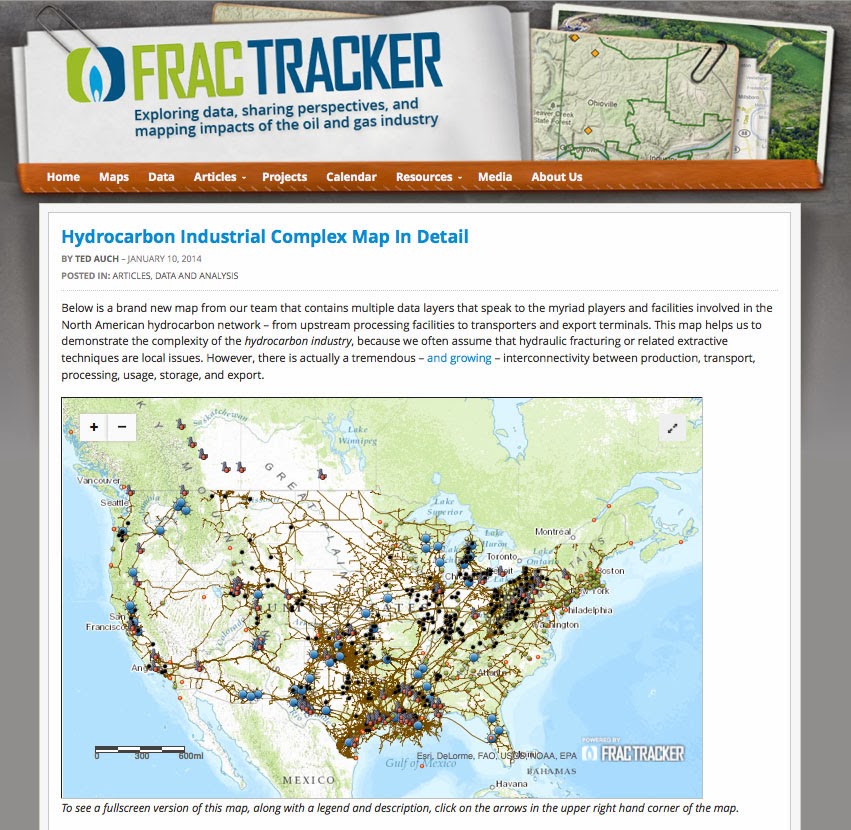
http://www.fractracker.org/2014/01/us-hydrocarbon-map/
[Originally posted Jan. 11, but I'm backing off much of my criticism a short day later on Jan. 12, after learning something new from a Natural Gas Forum for Landowners participant: 

1) The National Pipeline Mapping System's public viewer here currently resolves down to a scale of 1:24,000 (or 1" of mapped screen space representing 2,000' of on-the-ground reality) — and then at finer scales takes away the pipeline layers for national security reasons.  That's far more detailed than I previously would have thought advisable, but at least the decision is in the hands of officials, rather than activists. 

2) Based mainly on a single sample from my own personal knowledge of where the Dominion natural gas pipeline crosses the Tioughnioga River Valley — through "downtown" Blodgett's Mills, south of Cortland, NY — I'm concluding that the NPMS placement of pipelines is far more accurate and reliable than FracTracker, which in this case is off by miles.  With that as a "headnote" (rather than a "footnote"), I'll keep the rest of the commentary from my post intact, just because there is some useful information in there, and because it does show the evolution of my thinking.]

This is what I had to say on Jan. 10, 2014 in a not-yet "moderated" comment at the bottom of this FracTracker web page, which appears to have gone live earlier in the day:

A lot of the pipeline maps I see nowadays are highly generalized schematics, and I think there are legitimate reasons for that:  After 9/11, industry and the regulatory establishment made a concerted effort to withdraw detailed mapping of sensitive potential targets, such as what you appear to be showing here.

I can't say for sure whether your maps are intended to be truly accurate at an on-the-ground scale, but — if so — have you considered, before posting, that there might be an inherent conflict between the public's right to know, and the public's interest in discouraging vandals or worse from finding weak points at which to attack these things?

For what it's worth, here's what Wikipedia (currently) says on this topic (beneath a similar U.S. pipeline map which doesn't show much detail when enlarged):  "Many Americans have no idea where or whether a natural gas pipeline runs under their home or office, and since 9/11, for national security purposes, detailed maps of gas pipelines are not available to the general public" (emphasis mine).

I hadn't heard that there had been any relaxation in these guidelines (or whatever they are), but it looks to me as though you've taken matters into your own hands.  Beforehand, I think these questions are worth thinking about.
- - - - - - - - - - - - - - - - - - - - - - - - - - - - - - - - - -

Some further thoughts:

Pro-drilling commenters such as myself have grown accustomed to having their point of view "moderated" out of anti-drilling platforms — which is a polite way of saying we've gotten way too used to being alarmingly censored by the left.  This is especially true within the fracking debates
, which have gotten very over-heated.  We'll still have to wait'n'see what happens with my comment, which I intentionally drafted as politely as I could muster.  But let me just say, generally, that I don't cotton much to that kind of fanatical isolationism and closed-mindedness, whether it's coming out of the far right (where I previously considered it to be a natural reflex), or out of the far left (where I previously preferred to believe there were a lot of big fans of free speech).  It might be a little late in life for me to be finally learning this, but it turns out that George Orwell was correct to warn about the even-handed nature of the tendency toward Thought Police.

As somebody who's very much interested in the economic and environmental impact of the fossil fuels business, especially in New York, I have often wanted to know and report much more geographic detail about the existing and proposed sprawl of various pipelines and associated infrastructure. 

[Long digression here, and I'm sorry about that, but I think it's worth pointing out:  In New York State — due to the now-kindergarten-aged shale gas drill ban — there has been way more for me to talk about on this blog within the realm of midstream activity, rather than upstream.  For instance, Bluestone, I've written about at least once, twice, three, four times — always seeking with mixed results to goad the Binghamton Press into doing its job.  TGP's short-lived predecessor to Constitution, pro-drilling landowners had the scoop on that as broadcast here.  Constitution, during the early days, pro-drilling landowners and this blog were the primary source for details and first-draft maps here, and here, and here.  EmKey's mid-state proposal — which is not going anywhere anytime soon, so long as NY's frack ban continues — I've been pretty much alone in detailing.  Millennium South-North (and now South-North-But-Shortened), I've endeavored to get the word out here and here.  Iroquois' proposal to export natgas to Canada — for some reason, no one seems to think that's a story.  The recent plan to double what was originally called "Laser Gathering" in Windsor, I had it here, again seeking to coax the Binghamton Press into doing its job, which it eventually did.]

[More digression, and, again, I apologize:  Though it could be relatively easily done, no scribe, to my knowledge, has yet tried to pull together all this new activity — along with much additional inconvenient stuff, such as the Cornell University and Dunkirk coal-to-natgas power plant conversions; the anti-frack Village of Hamilton voting overwhelmingly to form a non-profit municipal natgas utility; Leatherstocking Gas winning franchises for very local natgas service in Windsor and other small towns nearby; NY's pending reversal on LNG as a cheaper and cleaner transportation fuel; the bipartisan consumer-level economic and environmental benefits of NYC's ongoing switch from fuel oil to natgas for building heat, including Yoko Ono's digs at the Dakota; Millennium upgrading compressors on downstate-bound pipelines; Spectra and others enlarging the capacity of their entry into Greater NYC; and even crude oil trains now wanting a barge transfer station in Albany — and used this full, seemingly disconnected roster of current news to illustrate The Big Picture:  All of this has been triggered by fracking!  In fact, like it or not, there has been a technological revolution in domestic fossil fuels that's already occurred, far outside the power of any state or federal governmental program to either make it happen, or to clamp it down.  And it's already affecting New York State in many good, bad, or traded-off ways — no matter what Gov. Cuomo ever decides on the in-state high-volume fracking question.]

Anyway, so far as pipelines in New York go, I have been admittedly frustrated by the post-9/11 clampdown on that kind of "general public" information.  And FracTracker's map looks like a decent answer to my wants and desires.  But, sometimes, I think, you know, you gotta be careful what you wish for.

It's true that a determined vandal, or a determined terrorist — similar to a determined burglar — would be able to find a place along the U.S. pipeline system to cause mayhem, regardless of official or voluntary attempts to withdraw sensitive geographic data from the general public's view.  But I don't think FracTracker's map helps matters much.  If anything, I don't think these guys — or their well-heeled anti-frack funders such as Heinz Endowments, Park Foundation, William Penn Foundation — are even thinking anymore.  Their cause is trumping all.

I'm just one person.  But I'm hoping that just talking about this might lead whoever's in charge of this sort of thing to quickly persuade FracTracker to make obsolete my links to their map.