Monday, July 11, 2011

Blog Exclusive: Record Deep Trenton-Black River Wildcat in the Pipeline

[Original post June 15, 2011. Additional context and a new map near the end.]

I happened to notice that Denver, CO-based Anschutz Exploration Corporation recently roused itself for a proposed return to drilling in New York's Southern Tier — asking the DEC
on June 8, 2011 for a permit to drill down into Trenton-Black River limestone, 9,783 feet beneath the Greible property, off Moss Hill Road, near Breesport, NY.

If it ever actually happens (and, for any readers new to the business, there are always more permits applied for, and granted, than are actually ever drilled), this would mark Anschutz's first new TBR well in New York in more than 15 months — ever since it spudded the Dow 2 on 3/2/2010, out near the Chemung County airport on the other side of Horseheads.

In fact, the enterprise of drilling is in such decline in the Former Empire State, the Greible 1 would mark the first fresh TBR activity by any operator statewide since MegaEnergy re-entered its Pimpinella wellbore (for an apparently successful lateral dubbed 1-B) in the Town of Tioga, Tioga County, NY, wrapping things up on 10/9/2010.

With regard to Anschutz, remember that, in November 2010, the privately held company was widely reported as having sold its northeastern U.S. leasehold to Chesapeake Energy.  But, it turned out a week or so later, the deal actually specifically excluded the NY-based portion of Anschutz's holdings.  At the time, few media observers were astute enough to say out loud that this was because Anschutz's upstate holdings had much less value — due to NY's tenacious state of regulatory uncertainty regarding shale gas.  Drilling the Greible as a TBR well represents pretty much all that Anschutz can do, at present, to have any hope of making any money on this expiring, undeveloped, unsold leasehold.

The fully drilled total distance
applied for on the Greible — depth, plus the turn, plus the horizontal — would be a jaw-dropping three miles, or precisely 15,921 feet.  Should it ever actually pay out, just the one single well is proposed to generate most-likely-12.5% royalty to all overlying, signed and unsigned owners of 670 acres. 

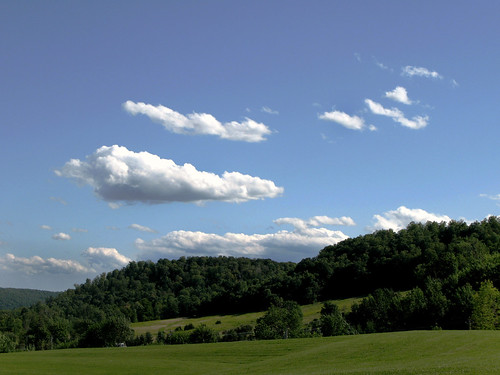
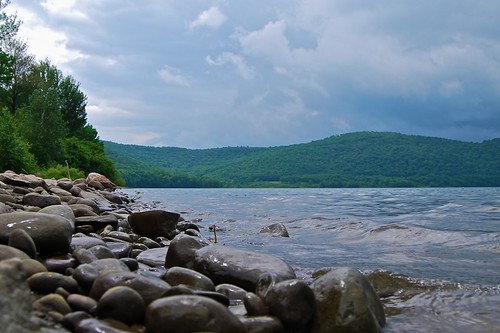
Breeseport by loki4200
Overlooking Breesport, NY, from Moss Hill Road,
a photo by loki4200 on Flickr.
[Digression No. 1:  This would have to be double-checked by somebody with direct access to the DEC's mainframe, but I'm pretty sure 15,921 feet of "bottom hole total measured depth" would represent a new record in New York State — again, if it gets drilled.  Based on my best reckoning — at least within the realm of modern-era TBR wells — the current record-holder for fully drilled distance would be the Ballymoney 1, a directional well that in October 2002 maxed out at 15,079 feet in a sorry, since-plugged, dry hole somewhere beneath the Town of West Union, in the extreme southwestern corner of Steuben County, NY.  Fortuna — as the U.S. subsidiary of Talisman of Canada was then known — paid the bills on that one.]

[Digression No. 2:  Just to give everybody an idea how big a production unit 670 acres represents...  If this unit were laid out in a perfect square (which it won't be, exactly, due to what is known about how natural gas flows from this limestone), it would run 5,402 feet from side to side — or more than a mile.  Nice box, if you're in it.]

[Digression No. 3:  At the time of this writing, Anschutz's permit application does not yet appear to have been synced up with the state's compulsory integration hearing process, which is sometimes also known as forced pooling.  It's unclear whether the company will seek to get through that bureaucratically supervised exercise before drilling, or afterwards.  The law governing this process was significantly modified in 2005 — in such a way as to envision that units would be decided before drilling, before anyone knew whether the well would be successful.  But it turns out it's also possible in certain cases to drill the well first, and then sort out the unit afterwards (if the well is not a dry hole).] 

[Digression No. 4 — added July 11, 2011:  (Click pic to see it all clearly.)  Data newly released by NYS DEC on July 1 allows a close observer to notice some additional significance to the pattern of Anschutz's TBR drilling activity running from Horseheads easterly.  First, it turns out the Number One producing well in NYS during 2010 was Anschutz's Center at Horseheads 1 — the surface location for which is about 3.2 miles (16,950 feet) by direct line northwest of the now-proposed Greible.  Center at Horseheads was spudded in the side yard of a suburban office campus as far back as 9/23/2008, but it only got hooked up to pipeline last year — producing for eight months out of the year.  The well generated 1,324,941 MCF — which is far short of a record, but the best of any statewide in 2010 — as spelled out in a table at the bottom of a separate post here, the first to call attention to NYS's latest production downturn.  Secondly, the Number 14 producing well in NYS last year turned out to be Anschutz's Ruger 1 — the surface location for which is 1.3 miles (6,930 feet) east of Center at Horseheads and 2.0 miles (10,500 feet) northwest of the proposed Greible.  The Ruger was spudded 2/26/2009 in an area near Newton Creek at the base of Bowman Hill (just east of State Route 13, but made inaccessible by that no-access highway).  The Ruger was also hooked up to pipeline during 2010 in time to generate 421,841 MCF during eight months that year.  The bottom line is that this looks like the same west-east-running TBR feature, a dolomitized graben, but re-pierced by the horizontally running drillbit every one or two miles.]

[Digression No. 5:  No word yet on whether New York's ever-louder, anti-drilling forces will mobilize in order to find a way to turn Anschutz's return to TBR drilling into a staged-for-media protest against New York's halting stutter-steps toward shale gas.
  Natural gas from tight shale is a different kettle of fish than trying for natural gas from dolomitized limestone — which requires no such full-monty frack completion — but, of course, that's too technical a distinction to make any difference in the current realm of street theater and political mayhem.]

[
Digression No. 6:  If anyone out there has not yet noticed that the battle against shale gas has now gotten officially way off topic in New York State, check out this article here from Steve Reilly of the Binghamton P&SB, covering a June 8, 2011, town board meeting in Coventry, NY.  On that occasion, the Granola People clogged the entrance of the town hall in order to argue against private-sector installation of a pipeline offering consumer-level natural gas service.  A week later — on the same pipeline question, but in a different town, Bainbridge, NY — the Anti Everythings tried to pull the same stunt, but the Local Worthies again turned out on short notice against themas recounted here by EID-Northeast.  Truly, it is getting a little crazy out there.]


The table below represents
the latest available information on drilling permits applied for, or permitted, or wells spudded, bottomed out, completed, or plugged — in just the more-central parts of New York, leaving aside WNY, where most oil and gas activity has traditionally been concentrated.  This covers about a month's worth of fresh paperwork, through approximately June 8, 2011.

The info has been distilled from recent changes to the New York State Department of Environmental Conservation's Wells Database, which you are more than free to search for yourself right here.

A close observer will note that there's more to drilling in New York than just oil and gas exploration and development.  In fact, this list of recent activity reveals three commonly occurring — but not very commonly known — situations where somebody would want to get a permit to drill a deep well, but without it having anything to do with producing new fossil fuels:

1) Storage of fossil fuels produced from somewhere else (see the Schuyler County entry).

2) Salt-mining in the form of brine (three wells on tap in Wyoming County).

3) Stratigraphic (the New York City Water Department wants to drill six different wells into limestone between 650 feet and 1000 feet deep, some right through the bottom of the Hudson River, just upstream of Newburgh, NY — probably as part of an upcoming aqueduct re-routing project).


Date Event Well Type
Formation
(Orientation)
Well Name Operator County
(Town)
Map It
6/8/2011  Permit
Applied For
Gas Wildcat
Trenton-Black River
(Horizontal)
Greible 1   Anschutz Exploration Corporation   Chemung
(Horseheads)
31015264880000 
6/3/2011  Reached
Total Depth
Gas Wildcat
Herkimer
(Horizontal)
Chiulli 161   Norse Energy Corp USA   Chenango
(Smyrna)
31017264840000 
6/2/2011  Permit
Applied For
Storage
Syracuse
(Vertical)
Finger Lakes 2   Finger Lakes LPG Storage, LLC   Schuyler
(Reading)
31097264890000 
6/2/2011  Spudded Brine
Salina
(Horizontal)
Hooker 169   Occidental Chemical Corp   Wyoming
(Middlebury)
31121278850000 
5/27/2011  Permit
Applied For
Stratigraphic
Wappinger Limestone
(Vertical)
RB-9A   New York City Dept. of Environmental Protection   Dutchess
(Wappinger)
31027270270000 
5/27/2011  Permit
Applied For
Stratigraphic
Wappinger Limestone
(Vertical)
RB-10   New York City Dept. of Environmental Protection   Dutchess
(Wappinger)
31027270280000 
5/27/2011  Permit
Applied For
Stratigraphic
Wappinger Limestone
(Vertical)
RB-9   New York City Dept. of Environmental Protection   Orange
(Newburgh)
31071270260000 
5/25/2011  Permit
Applied For
Gas Wildcat
Herkimer
(Horizontal)
FRANKLIN D 1H   Norse Energy Corp USA   Chenango
(Preston)
31017300100000 
5/23/2011  Permit
Applied For
Stratigraphic
Wappinger Limestone
(Vertical)
RB-1   New York City Dept. of Environmental Protection   Orange
(Newburgh)
31071270230000 
5/23/2011  Permit
Applied For
Stratigraphic
Wappinger Limestone
(Vertical)
RB-2   New York City Dept. of Environmental Protection   Orange
(Newburgh)
31071270240000 
5/23/2011  Permit
Applied For
Stratigraphic
Wappinger Limestone
(Vertical)
RB-3   New York City Dept. of Environmental Protection   Orange
(Newburgh)
31071270250000 
5/21/2011  Spudded Brine
Salina
(Horizontal)
Hooker 168   Occidental Chemical Corp   Wyoming
(Middlebury)
31121278840000 
5/19/2011  Permit
Applied For
Brine
Salina
(Horizontal)
Texas Brine Company 106   Texas Brine Company, LLC   Wyoming
(Middlebury)
31121276420100 

[Place-holder]

Wednesday, July 6, 2011

Three Years of the Shale Gas Revolution:
And Conventional Drilling Crashes in NY

Online records covering oil, gas, and other wells from the New York State Department of Environmental Conservation show the number of newly "spudded" wells has dropped between 44 and 62 percent compared to 2008 — a time period covering three full years of a hotly contested shale gas freeze.

Counting all oil and gas wells — and even including non-fossil-fuel-producing wells such as stratigraphic, brine, storage, and geothermal — the state's database shows the number of wells started dropped from 541 in 2008 (the last year of a very high, three-year run) to 297 in 2009, 302 in 2010, and 208 in 2011.  The 2011 numbers are based on a full-year projection, running forward from where the stats stood as of the half-year mark on June 30.

Looking at the numbers of wells permitted — some of which have not been drilled, may never be drilled, or were not drilled in the same calendar year — approved applications from industry dropped between 25 and 60 percent
, from 738 in 2008 (the highest of three very active years) to 552 in 2009, 472 in 2010, and on track for 298 in 2011.

Examining all wells completed — some of which may have been permitted or spudded in prior years — the decline in activity is similar:  Down between 40 and 75 percent, from 536 in 2008, to 280 in 2009, to 322 in 2010, and a projected 134 in 2011.

By pretty much any measure, the numbers from 2011 indicate NY is on a pace to rack up its worst year for drilling since 2003 or 2004.

Note that these numbers are based on the online records for all 4,371 wells permitted in New York State since 1-1-2000, as those records electronically existed on 7-6-2011.  Drilling permits applied for, but never granted, were not covered.  It is also likely that there will be a number of 2011 records which had not yet been entered into the database as of 7-6-2011.

I also happened to notice that — sometime since July 1 — the DEC has rearranged its online well production database to allow for queries covering 2010 oil and natural gas production, although I haven't yet had a chance to try delving into that data.  Summaries of these statistics are typically compiled by the DEC Minerals Division in an annual report released to media, and posted online here, around late July of each year, and covering the previous full calendar year.  The production records are based on filings from industry that are due March 31, but which are held in confidence until July 1.

A year ago, New York State natgas production was reported to have dropped about 11 percent by volume in 2009, compared to 2008.  If the stats on wells permitted, spudded, or completed are any guide, then 2010 should have witnessed a similar or worse dropoff — especially when factoring in the natural declines in production from any already drilled well.

Note that the drop in wells permitted, spudded, or completed since 2008 is not directly due to the state's Marcellus moratorium serving to freeze out a large number of previously existing projects.  That's because none of the New York drilling records (before or since 2008) has ever included a permitted, full-on, full-horizontal, full-fracture shale gas well.  Before February 2008, industry had not yet ever proposed such a project in New York, and no such permits have been granted since, due to a sequence of administrative moratoriums, which are now on track to be lifted in 2012.

In Pennsylvania, the first such well was drilled and fracked without publicity as early as October 2004.  A number of additional gas-bearing eastern states — namely Ohio, West Virginia, and Michigan — have since found ways of following PA's lead, without getting bogged down in much political controversy.

New York, on the other hand, has witnessed a drilling decline which appears indirectly related to the moratorium, acting in conjunction with dramatically increased investment focus on unconventional shale gas, to the exclusion of more conventional source rocks.

Industry has chosen to drill fewer such traditional wells in New York (which the state has always permitted, and which it still permits, both before and since 2008), and is instead transferring much of that investment capital to shale gas developments in other states, such as Pennsylvania, where there has been much less regulatory holdup.

In Pennsylvania, the amount of oil and gas activity — even based solely on the most conservative counts of actively drilling rotary rigs — has gone virtually off the charts from 2007 to date, driven largely by the boom in developing horizontal wells in the Marcellus shale formation.

Cuomo: Okay, Let's Get Fracking, NY
...But First Some Inconvenient Questions

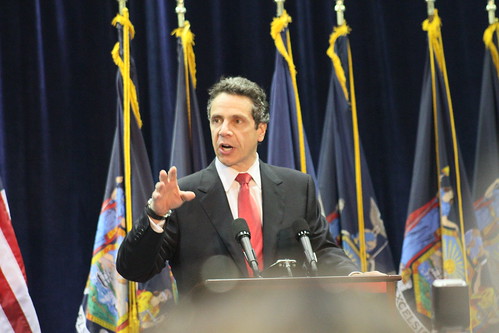
IMG_1621 by ad454
Then-gubernatorial-candidate Andrew Cuomo, at a rally in
Brooklyn, Oct. 27, 2010 —
a photo by ad454 on Flickr.
After three painful years of having to listen to all kinds of wild-eyed persuasiveness, New York State's Cuomo Administration on July 1 boldly announced it could finally see a clear way ahead to allow industry to develop its own landowners' shale gas.

To me, of course, that's great news.

But I'm already noticing that few observers have yet given much attention to all the ground that had to be given up, in order to move forward with this plan.

The most noticeable retreat is the now-presumably-indefinite frack ban in the unfiltered drinking water collection areas up in the Catskills Mountains (New York City water), and anywhere uphill of Skaneateles Lake (Syracuse water).  Don't look now, but those landowners just got their property rights shaken down — and not a soul dares to suggest that this oppressed minority really should be fairly compensated by the free-riding majority.  (Which just kills me.)

Secondly, and similarly, there is also a now-presumably-indefinite prohibition against any drilling directly over primary aquifers.  This is new.  This is a public decision which suddenly devalues, for oil and gas purposes, thousands of privately held acres sitting in a pattern approximately mirroring the major river valleys.  Industry could drill some of this by reaching horizontally from the sidelines.  But not all of it.  And so large volumes of this finite fossil fuel resource are now stranded indefinitely.  Basically,
the "public interest" is now putting off limits this privately owned natural resource, but without ever offering to buy (or rent) the rights.  Again, it just kills me how little concern is shown for these landowners.  In fact, most of these landowners probably don't even realize that they've just been stripped of significant rights, nor do they comprehend what it all might be worth, even just in current dollars.  I believe they would be pretty pissed off if anybody succeeded in explaining it to them.

[It also kills me how little of a demonstrable connection has been made between the actual drilling, and the actual fracking — and the presumed threat to groundwater.  I understand the political connection
— believe me.  But I don't understand the environmental connection.  If there is, in fact, a particular, realistic environmental risk from natgas development in these river valleys, then I say you've also got some highways to re-route, some railroads to shift, many businesses to relocate, a whole lot of private leach fields to plug, and even more road salt, pesticides and herbicides, and manure that you really should stop spreading in those areas.]

The third outpost where New York State really threw up a bunch of white flags is that leaders are now proposing to turn their backs on the state's own shale gas resources — that is, what's sitting underneath thousands of acres of state land — and also to turn their backs on the deals that the state already made regarding some of that land.  Running forward, the state itself is the landowner, and so I fully support that it is entitled to make up its own mind, just like any private landowner.

But what about the deals the state already made?
These are the 19,227 acres of state forest land New York State leased to the natural gas
industry for five years, starting 11/15/2006 — about half of which did, in fact, allow for
surface drilling operations:  Broome/Tioga 1 = Tracy Creek; Cortland 1 = Hewitt;
Cortland 3 = Kennedy; Cortland 9 and 10 = Tuller Hill; Tioga 1 = Fairfield;
Tioga 2 = Oakley Corners; Tioga 3 = Robinson Hollow; Tioga 4 = Anderson Hill;
Tioga 6 = Ketchumville; Tioga 7 = Jenksville; Tompkins 4 = Potato Hill;
Chemung 1C = Catlin; Chemung 2 = Maple Hill; Schuyler 4 = Coon Hollow;
Steuben 5A = West HIll.
In 2006 (a much earlier time and place, it turns out), New York State without much fanfare or controversy gave five-year leases to the natural gas industry covering 16 tracts of state forest land totaling 19,227 acres spread across seven different counties.  Chesapeake and Fortuna (n/k/a Talisman) were the winning bidders, and the state land was distributed in Chemung, Cortland, Schuyler, Steuben, Tioga, Tompkins, and Broome counties — some turning out afterwards to be located in very prime, Marcellus shale position.  (If you want proof, or all the details, go here.)

The total income from signing bonuses was $8,988,368.54.  If you include delay rental (then fixed beforehand by the state's bidding specs at only $5 per acre per year), then the total income rises to nearly $9.5 million.  That's with no
royalty — and, as it turns out, no chance of royalty — since, to my knowledge, not a single well of any type has yet been drilled on or near any of this land.

In 2008 — 20 months into these 60-month-long leases — NYS put up a temporary de facto ban on shale gas development statewide.  Now it's 2011 — Year Five of these five-year leases — and NYS has finally proposed to get its ass moving on shale gas.  But shale gas won't happen until 2012, at the earliest, by which time these leases will have expired (assuming there won't be any last-minute success in exploring more conventional horizons). 

Meanwhile — in a desperately short-sighted attempt to appease the frackophobic lynch mob — all surface operations atop all state land just got thrown under an indefinite ban (but only if shale gas is the objective).

The DEC Mineral Division's 2010 annual report on state lands leasing — downloadable as a PDF here — reports that all these 2006 deals were made effective 11/15/2006, which means, absent development, they will expire soon, 11/15/2011.  A close observer would be able to surmise that
Chesapeake, or Talisman, or successors to whom they may have assigned, are now facing a very delicate decision on deadline:  Should they seek a refund on any part of their $9.5 million?  Or should they simply chalk it up to bad planning — in an effort to keep the political peace necessary for New York to finally open up its privately owned shale gas prospects?  Or should they get ahold of the state in order to formally claim extensions on their five-year terms — due to the unforeseen event of "force majeure," or superior force, represented by the three-plus-year-long regulatory disruption over shale gas?  Lastly, if such extensions are won, should they assert that these deals from 2006 effectively grand-father in shale gas drilling operations on state lands?

These are all great questions that nobody is asking, and I would like to suggest that the silence is conspiratorial among New Yorkers — few of whom want to rock the boat we're all sitting in.  But, really, the question boils down to this — what do us New Yorkers want to do about the $9.5 million our state took from the private sector in 2006, in a deal for which it afterwards used its regulatory power to welsh on? 

It's one thing to have natural disasters, famine, civil unrest, wars, or regime changes rewrite the rules of the game between two private parties.  I understand that.  That happens all the time.  And it's one of the risks of doing business — although you don't often consider the developed world to be such an unstable banana republic sort of place. 

But, in the case of disruptions which have in fact been caused by New York State, this is a situation where one of the deal makers itself unfairly used its regulatory power to change the rules of the game, right in the middle of the game.  Nobody cries for the gas companies — I understand that.  But the American system of justice doesn't ever openly propose to distinguish between unfairness against a little guy, and unfairness against a behemoth. 

And it shouldn't.

These same questions of fairness can also be now asked about the state land put out to bid during auctions held in 2003, 1999, and even prior.  The last time I looked at these numbers, I calculated that NYS had already put 51,764 acres of public land under lease to winning bidders, out of which 32,537 acres were still active under older leases because those leases continued to be indefinitely held by production (HBP), long past their face-value primary terms.

Now New York wants to say — Sorry!  No shale gas development on that land!  How do you figure?  How is that going to look to a judge?  You ask me, I say New York is going to owe a significant refund on the $9.5 million deal from 2006.  And New York is going to have to grandfather in all the HBP acreage from prior auctions, leaving it open for shale gas drilling, running forward — despite all the promises it has made in order to settle the irrational passions of the frackos.  To do anything else is to openly do injustice under existing deals.

Monday, July 4, 2011

Update 1: Otsego County NIMBY Group
Quickly Loses Gastem Challenge

Clouds over Cherry Valley by Keturah Stickann
Clouds over Cherry Valley, a photo by Keturah Stickann on Flickr.
[Original post June 20, 2011. Minor update at end.]

A NIMBY group calling itself Advocates for Cherry Valley launched a legal challenge
in May in hopes of obstructing a low-volume frack in a vertical Utica shale well by Gastem USA, the American subsidiary of a Canadian company. 

But, just last week, they had their petition rejected by the NYS DEC, some 40 days after filing — which seems like it ought to be some kind of new record for swiftness.

I was looking for something else earlier today, when I happened to notice the ruling by the DEC's Chief Administrative Law Judge — dated and posted June 13, 2011, pretty short and sweet, and readable online here.

The dispute ostensibly concerns the Sheckells 1 well — off Irish Hollow Road, Town of Cherry Valley, Otsego County, NY — which was originally bottomed out in Utica shale by Covalent Energy
in September 2007, back prior to the time period when Marcellus shale mania exploded across upstate.

Successor Gastem, in September 2010, won DEC permission to hydraulically fracture the shalebed with less than 80,000 gallons of fluid, which qualifies as a low-volume "stimulation" that's already blessed under existing regulations and environmental studies.  (Contrary to widespread public confusion on this point, only high-volume hydraulic fracturing remains frozen under both versions of New York's famous shale gas moratorium.)

For one reason or another, however, the frack on the Sheckells hasn't yet actually occurred — although Gastem's home page does link to a press release touting a similar completion given to a vertical Marcellus shale well, the Ross 1, in the Town of Maryland, further south in the same county, around December 2010.

In May 2011, the Advocates put together a challenge against the Sheckells 1 on procedural grounds.  All I know
about the so-called Advocates — and all I need to know — is that they originally formed in 2002 in order to (soon-thereafter-successfully) kill a $50 million wind power project proposed in the neighborhood — which, to me, represents instant loss of any possible credibility as a bonafide environmental organization.

The original 18-page letter of complaint, written by lawyer Peter Henner from Clarksville, NY, is dated May 4, 2011, and is online with Google Documents here.

What the maneuver tried to do, in a nutshell, was to force the DEC to shelve the Sheckells job (and conceivably any similar completions statewide) under the same yellowing stack of indefinite delay now aging to Year 3 — and preventing the horizontal shale gas revolution from getting started in New York.  The effort didn't work, but you'd need to a lawyer to explain where their arguments went wrong.

A couple real-world observations, though: 

Notice that the NIMBY group didn't have any trouble whatsoever winning mainstream press coverage immediately after filing their complaint (appearing in the Albany Times-Union on May 6, and in the Oneonta Daily Star on May 10).  But — after they lost — where is the media?  Apparently neither of these outlets know how to follow up without prompting — and mum's the word from the Advocates, obviously. 

Notice, also, how many dollars and hours and days the opposition must have put into researching just this one well, and just this one case.  Their complaint letter appears to reference every communication running forward or back between Gastem (or predecessor Covalent) and the DEC, since the original permit application in 2007.  Clearly, these folks have much deeper pockets, and much more time on their hands, than is popularly imagined.

[Update 1:  Tom Grace of the Oneonta paper did ultimately get a move on and let the public know about this quiet setback for drilling opponents, as can be seen here in his July 1, 2011 story.  But I still haven't heard boo out of Brian Nearing at the Albany paper — even though he was Johnny-On-The-Spot when the NIMBY PR first hit the fan.  I emailed him.  I emailed both these guys.  What gives?  That's what I want to know.  Have the rules of journalism changed?  To me — if it's news that the activists filed, then it's news that their case later fizzled.]

Wednesday, June 29, 2011

Quick Comment on an Anti-Drilling Blog:
In Defense of Those Who Protest the Protest

Pro-gas landowners in upstate NY have put together a welcome wagon of sorts — to occasionally greet their frack-fearful counterparts at certain local happenings.  This was part of the display in the parking lot of the Vestal American Legion, just before a traveling group of anti-drilling lecturers took the stage.
On June 22, pro-drilling landowners loosely organized by the Joint Landowners Coalition of New York essentially crashed an anti-drilling roadshow held at the Vestal (NY) American Legion. 

(Technically, "crashed" is not the right word, because the meeting was open to the public.  But you get the idea.)

If you'd prefer to hear about all this in a mocking way that takes the pro-drilling side, go to this post from Energy In Depth's Northeast Marcellus Initiative — where industry is now openly employing writerly firebrands at the level of street organizer, similar to the way that unions, social justice, and other left-wing-activist organizations have long operated.

Or, if you'd rather hear about it in a sympathetically anti-drilling way, check out this post from Sue Heavenrich's generally not-to-my-taste Marcellus Effect — a blog which appears to represent nearly two years of subtly persuasive journalistic labor (and probably very little of it paid for).

Or, if you'd rather hear about it from a professional journalist with theoretically no financial, social, psychological, or ideological stakes in either side of the Late Great Hydro Fracking Debate — sorry, I don't think anybody was there, other than TV people, and I don't consider TV people to be professional journalists, at least not most of the time.

Anyway, comment number three on Heavenrich's blog took me by surprise.  It goes like this: 
Anonymous said...

This militant group that supports drilling known as the Joint landowners colilition of New York, normaly uses direct action type of protest when attending NYRAD events with speakers. They show up disrupt the event and then after NYRAD came out with the clean water signs they bought a bunch of them and placed JLCNY stickers over the NYRAD website printed on the sign. The funny thing was this was the second time at a NYRAD event where the Vestal Police had to show up due the militant type of protest the JLCNY seams to favor. This group seems to have a type of rabies that makes it imposiable to have a dialogue with them.


BRETTJ

Councillor, Great Bend Borough
Unless this was posted by an imposter (or, rather, an imposter who's not a very good speller), this appears to have been quickly written — with a typo — by Bret Jennings, whom Google searches show to be an anti-drilling elected official on the Borough Council of Great Bend, on the Mighty Susquehanna, upstream from Binghamton, NY, in Susquehanna County, PA.  Jennings also appears to have a hand in directing the sewage treatment plant down there, and — for the sake of my buddies in Binghamton — I hope he does a better job with that than he does with his pronouncements against pro-gas landowners.

Anyway, it bothered me enough that I wrote in to Heavenrich's blog, and I choose to re-broadcast my remarks here — in order to keep them on record for a little bit longer, and in order to get the word out to fundamentalists on all sides.

NY Shale Gas Now said...

The comment from BrettJ is intriguing to me in the use of such loaded persuasive imagery as "militant," "disruptive," and "direct action" — to describe the fact that pro-drilling landowners organized themselves in order to essentially protest the anti-drilling protest.

If you are committed to the traditions of protest and free speech — as I believe most anti-drilling people are (or would be, if reminded) — then you must accept the fact that ordinary people are sometimes also going to strongly disagree with you — occasionally in noticeable, dramatic (and, yes, even somewhat disruptive) ways.

No, I was not at this meeting. But — frankly, judging from the pictures, and from what I've read about it elsewhere, and from the pro-gas landowners I have met — many of these people are the very same sort of folks as you'd find at a fireman's pancake breakfast anywhere within upstate.

I don't believe taking it to the streets is much a part of their tradition, or part of their fate. (But — the way things are going — who the hell knows.)


But look how quickly the word choices demonize.

Saturday, June 25, 2011

July 1, 2011 — 7 Reasons Why it Won't Be Independence Day For NY's Landowners

IMG_1653 by ad454
Then-candidate Andrew Cuomo, at an Oct. 27, 2010
rally in Brooklyn, a photo by ad454 on Flickr.
July 1, 2011, that's the day, Cuomo said so — the day New York's landowners would finally see some regulatory headway on shale gas.

As this date approaches with a crescendo (and surely passes us by, with one roar or another), I think it's worth reminding everyone of some insufficiently considered recent history in New York State.

As of July 1, folks who happen to wittingly or unwittingly own shale gas under upstate New York will have been restrained in the exercise of their private property rights for nearly three full calendar years, and by seven different shale gas moratoriums.

Seven!  (Yes, it's true, that's including two bans which were proposed, but which were pushed back in the final hours.)

But, still, seven!  It's not a good sign.  Let's break it down.
¬ ¬  ¬   ¬    ¬     ¬      ¬       ¬        ¬         ¬          ¬           ¬            ¬             ¬
A hydraulic battery fracking shale from a vertical wellbore deep within Gastem USA's Ross #1, Town of Maryland, Otsego County, NY, November, 2009.  Many people don't realize that New York doesn't actually have a ban on fracking (which is technically standard operating procedure for completing most modern wells).  But it does currently have a freeze on high-volume fracking.  Reps from the DEC, the DOH, the SRBC, the Sierra Club, and Pro Publica were on site to see this operation, one of the first shale gas tests in New York.  Full PDF here.
THE FIRST BAN — A DE FACTO MORATORIUM STATEWIDE

The first ban — which was always phrased as a temporary measure — traces its origins to a between-the-lines reading of a July 23, 2008 press release (still online as a PDF here), issued by then-Governor David Paterson.  On the surface, the governor had simply announced he had directed his DEC to update its 1992-vintage environmental impact statement generically covering all oil and gas drilling — in order to address any previously unforeseen, unknowable impacts from the much more involved operations necessary for carrying out the shale gas revolution.

Seems reasonable.  And the words "ban," "freeze," or "moratorium" appear nowhere in this press release. 

But the full ramifications sank in shortly thereafter.  T
he DEC let it be known that it was shelving indefinitely any drilling permit application for any project which envisioned using more than 80,000 gallons of hydraulic fracturing fluid during the well-completion phase.  That was the cutoff — not horizontal versus vertical, and not shale versus any other rock layer — but a basically arbitrary measure of the number of gallons of fluid needed to get the natural gas flowing.  For anything more than 80,000 gallons, the DEC was taking the blanket position that the environmental impacts hadn't yet been sufficiently studied, at least not by the almighty State of New York.  Anything less, you could still get a permit for, and several companies already have.

This First Ban became known as the De Facto Moratorium, because — at least in legal theory, if not in actual business reality — the natural gas industry was still technically free to seek a permit to drill a full-scale well in Marcellus or Utica shale.  The only trouble is, the driller would have to first commission their own site-specific environmental impact statement.  
And then, of course, they would have to have the public hearings, and the public comments, and the second draft, and so on.

[Good luck with all that, in other words.
]

Another important point worth remembering — but very often conveniently forgotten — is that there was never any deadline to the First Ban.  In fact, as we shall see, this First Ban still essentially lives on as the Seventh Ban.  What's happened is, the DEC's drawn-out, environmental review process fulfilled its underhanded political mission — by becoming a stage upon which anti-drilling activists were given free reign to direct a very public chorus statewide, calling for further delay, which is always a politically easy thing to call for.


¬ ¬  ¬   ¬    ¬     ¬      ¬       ¬        ¬         ¬          ¬           ¬            ¬             ¬

THE SECOND BAN — DELAWARE RIVER WATERSHED INSIDE NY

This ban — which is a ban that manages to wind up overlapping all the other bans, just in case the other bans aren't strong enough — doesn't have statewide coverage.  Within NY, it only affects those 2,362 square miles which happen to drain toward the Delaware River, some unknown portion of which — within
Broome, Delaware, and Sullivan counties — likely has any shale gas potential.

Why is this area special?  In this area, there is an extra-added, bonus layer of regulation which New York State allowed to get started, way back in 1961, when it agreed to join the Delaware River Basin Commission.  The DRBC is a federal-state compact formed between NY, PA, NJ, DE, and the federal government, acting through the flood control experts at the Army Corps of Engineers.

On May 19, 2009, the DRBC formally asserted for the first time in its history that it held additional jurisdiction — on top of, or alongside, whatever the PA DEP or the NY DEC might want to do — over all oil and gas development in "its" watershed.

Note that there's a very similar, neighboring river commission, the Susquehanna River Basin Commission (SRBC) — formed by the feds together with NY, PA, and MD — which also contemporaneously asserted that it held rights to additional jurisdiction over gas drilling.  But the SRBC somehow managed to implement its regulatory program within months of starting out, strictly limiting its efforts to a fulfillment of its primary mission of having a say over water use in the watershed.  At this point, the SRBC's water-withdrawal permitting scheme is basically a well-oiled machine which you are more than free to see for yourself, in action, right here, on the web.

The DRBC, by contrast, takes a much more lumbering view of its powers.  The proposed regs are very far-reaching, and yet still under review.  Many thousands of comments have been received.  These things take time.  Like it or not, we must accept that this tangled web of obstruction and delay is, in fact, a policy that's endorsed by a majority within the dynamic imposed by the five-seat roundtable of NY, PA, NJ, DE, and the Obama Administration's Army Corps.

[Something's going on here — something which has not yet been fully reported.  And something which has completely stalled the property rights of anybody owning land in this watershed, PA or NY.  I think it's got something to do with what the rep for NY is being told to do, under Paterson, and now under Cuomo.  If it were up to just Obama, PA, and NY, then we should see drilling already in this area for domestic fossil fuels.]


¬ ¬  ¬   ¬    ¬     ¬      ¬       ¬        ¬         ¬          ¬           ¬            ¬             ¬
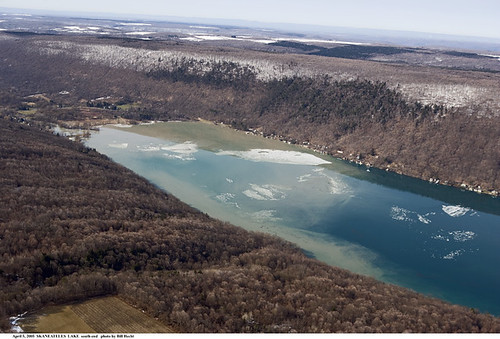
Aerial-SkaneatelesLakeLookingSouth2005 by lvanvlee8
South End of Skaneateles Lake Looking Southwest, from a nice collection of Finger Lakes aerials by Bill Hecht appearing on the account of lvanvlee8 on Flickr.  Yes, I do believe the grayer cloudy stuff visible in this unfiltered public water supply is naturally occurring sediment.
THE THIRD BAN — CATSKILLS AND SKANEATELES

It's true this ban is also only a partial ban, geographically, but it's still very significant.

On April 23, 2010, then-DEC Commissioner Alexander "Pete" Grannis announced his agency would essentially keep the original de facto ban in place permanently against any land which happened to drain its snowmelt and rainfall toward the unfiltered drinking water collection systems of the City of New York, or the City of Syracuse.

Whatever the specialists with the DEC Minerals Division might be cooking up with the SGEIS, it wouldn't count in these areas, the political people determined in advance.


What this amounted to was this:  Taken aback by the anti-fracking firestorm then sweeping the public conversation statewide, the Paterson/Grannis Administration had made a half-hearted, too-little, too-late, political effort to soothe the Per Capita Majority.  They announced there would be no shale gas developments allowed in the Catskills areas upstream of New York City's numerous water reservoirs, or in the rural areas of Onondaga, Cortland, and Cayuga counties which are upstream of Skaneateles Lake, where Syracuse draws its water.

I think what they were innocently thinking was — maybe then there would be way fewer New Yorkers who cared enough to spend all their free time, going to war against shale gas.


What's most interesting to me is the preposterous regulatory distinction forming the basis for how they proposed to regulate different areas in different ways.  It ostensibly had to do with filtration of public water supplies — or the lack thereof.  But this very quickly tumbles as a thinly disguised and completely disingenuous excuse.  Beyond hum-drum sediment-control issues, the most alarming of any possible contaminants from a well pad would easily pass through any conceivable filter.  (Salts?  Hydrocarbons?  Glycols?  Forget-about-it!)

In short, filtration is a smoke screen; politics is the true distinction.


[About the filter issue:  NYC and Syracuse — for economic and political reasons, but not for reasons of public health — have long fought federal regulatory pressure to filter their water supplies, in the same way that pretty much every other water department has already been respectfully required to do.  The leaders know that the best way to keep these big-city, money-saving regulatory exemptions rolling is to keep alive the feel-good premise that these water departments were already cooperatively, peacefully, harmoniously, greenly, and sustainably managing all private economic activity upstream, so as to keep the water clean.]

[The word "pristine" is used a lot, along with "precious," and also "pure."  Never mind that livestock, wildlife and certain human individuals I happen to personally know are also routinely "peeing," "pooping," and "powering" their fossil-fuel-powered watercraft in that very same watershed every chance they get.  But — in the same way that Applebee's don't sell the steak, it sells the sizzle — well-educated, well-meaning, and well-paid environmental professionals have been very-much-willingly seduced into routinely bamboozling the unwitting public with the completely unscientific notion that there's something vaguely warm, embracing, and motherly about not filtering your urban drinking water!]

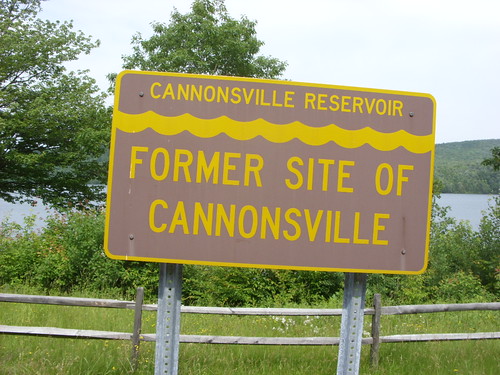
New York State Route 10 by dougtone
Former Site of Cannonsville, a shot taken taken by dougtone on Flickr, while traveling State Route 10 which parallels the Cannonsville Reservoir.  This is upstream of Deposit, NY, on the West Branch of the Delaware River.  Cannonsville was one of two dozen Catskill towns sacrificed in order to supply New York City with water
The mechanism for imposing this kind of majority belief system upon the minority interests of people who owned the land — and upon people who have jobs, and upon people who wished they had jobs — was the same tourniquet which prevented any full-blown shale gas drilling from happening statewide after July 23, 2008:  The DEC was simply going to demand a full-blown environmental impact statement for every job.  The policy people were, in essence, borrowing a trick from the activists — using the environmental review law to do a blunt, irrational, and obstructive job for which it was never originally intended.

[Imagine if neighboring PA insisted on all this paper from consultants — for all the thousands of Marcellus wells that have been permitted to date!]


Cannonsville Shoreline by kmitschke
Cannonsville Shoreline, a photo by kmitschke on Flickr, who writes: 
"
It smelled like a wet dog so bad, but nobody was in sight!
This is where New York City gets a lot of their water from... 
Note to self:  Don't drink NYC tap water."
Again, like the First Ban, and like the Second Ban, the Third Ban is still in place — although you would never know it by reading the current assaults upon shale gas coming from anti-drilling groups with constituencies in those areas.

Why is that? I ask.

That's because — if there isn't a current crisis, with the Fate of the Earth hanging in the balance — then the anti-drilling groups lose a key reason for their very existence.  Honestly and truthfully calling attention to the already installed Third Ban — the permanent Catskills/Skaneateles shale gas ban — only serves to make their drama seem a tad overwrought, shall we say, in the minds of too many millions of people.  And so opponents don't like to talk about it much.  And — since opponents currently generate or spin probably 90 percent of the information floating around out there, measured by weight or volume, regarding this issue, at least in the Northeastern U.S. — that's why most New Yorkers have completely forgotten that New York State has already taken the New York City (and Syracuse) drinking water question off the table, frackwise.

Whether there was ever any legitimate, novel, or unmanageable threat to this drinking water — it doesn't matter; it's off the table.

Note also that the Third Ban has had no political or legal difficulty in fulfilling its literal objectives.  I think it's fair to say that drilling in these discrete watershed zones — barring some kind of major, apocalyptic, Mad-Max-style global energy crisis — is simply not going to happen anytime soon, because there will be no way politically to go back and change what's been done.  [In fact, the property rights of these private landowners have already been successfully whittled down considerably.  And there hasn't even been a lawsuit (yet), politely requesting compensation.  Amazing, to me, sometimes, the sort of abuse that landowners will put up with.]

Note further that the Third Ban has completely failed to fulfill its between-the-lines objectives:  It hasn't caused the opposition to take a chill pill and settle down on the fracking question.  On the contrary, if anything, it's only given them more ammunition:  Why distinguish between filtered and unfiltered water systems?  Why distinguish between drinking water drawn from the surface, and drinking water drawn from underground?  Water is everywhere.  Land is everywhere.  Why not treat it all the same?  Why not ban everything?  And so on.

THE FOURTH BAN —
THE LEGISLATURE BARGES IN

In this version of the moratorium, both houses of New York's Legislature got into the act — over two separate months in 2010 — by seeking to answer the clamor from activists for a more definite freeze on fracking.  Legislators by wide margins passed a ban designed to temporarily run until May 15, 2011, a time period in which the body could be expected to be annually in session, running forward, making renewal a convenient rite.

Industry critics asserted the Legislature's sloppily worded measure — crafted without even the slightest inkling of respect for the meanings of various geological terms, or industry jargon, or what it what would all mean in the real world of actual jobs and actual people — would have brought nearly all still-existing drilling to a standstill, mostly in Western New York.
Believe it or not, the ordinarily reluctant NYS Senate went first, Aug. 4, 2010, and the vote was a crushing, 48-9, in favor of the Fourth Ban.  It was a bit of a cake walk, I think, for frack opponents.  In hindsight, industry and the resource owners were caught off guard.  I think it's also fair to say, in hindsight, that this was the wrong thing to do — especially for upstater legislators, and especially for upstate Republican legislators.  But at the time it was politically impossible for these folks to see their way clear to publicly do the right thing.

The NYS Assembly vote came much later, on Nov. 29, 2010.  And the vote was a more realistic, 93-43.  It pains me to say this, but I think those numbers are the real deal.  And that is the work which lies ahead, for anybody who wishes NY could find a way to safely bring the shale gas opportunity to fruition here.

THE FIFTH BAN — THE BEST DEFENSE DAVID PATERSON COULD MUSTER

On a Saturday, December 11, 2010, just before leaving office — as though in answer to a public plea I posted here — Gov. David Paterson vetoed the legislature's effort in a bold, intelligent, well-principled move — for which I will remember him fondly, forever-more.  Paterson said what the Legislature was up to was largely symbolic, but with job-killing implications — and that he wasn't going to be the guy to take people's jobs away, for symbolic reasons.

[Thank you, David!]

In the same statement announcing his veto of the legislature's frack ban, however, Paterson softened the blow by creating the Fifth Ban — formalizing the existing administrative ban with an executive order which extended it until June-July 2011 at the earliest.

Incoming Governor Andrew Cuomo later seconded this order, and later still firmed up the deadline for a new Governor's-Eyes-Only draft from the DEC — July 1, 2011.

And so that's where things stand right now. 

But let us not forget that that date would fall at nearly the Three Year Anniversary for the Empire State's having completely balked at the onset of the shale gas revolution.


THE SIXTH BAN —
THE ASSEMBLY BARGES BACK IN

On June 6, 2011, the NYS Assembly passed 96-46 what I'm calling the Sixth Ban — a symbolic, one-house measure.  Basically, the downstate-dominated, Democratically heavy Assembly renewed the exact same wording of the moratorium that former Gov. Paterson had so pointedly vetoed months previously.  The only difference was they changed the end date to June 1, 2012.  And the vote was 96-46, rather than 93-43.  I am still trying to figure out how to ascertain who changed, or what districts changed.  (Anybody?  Anybody?)


There's a video online here where — at the 5:26 mark, in answer to a reporter's question — Assembly Majority Leader Sheldon Silver, with all apparent sincerity, reveals that his group took this act partly because they actually feared the Cuomo Administration would start issuing drilling permits shortly after the July 1 SGEIS deadline — while they were out of session, and thus incapable of having any influence over the situation.  Clearly, Silver (and these other people in the background with the seriously clenched jaws) is either a really good actor — or else he is the most naive observer to ever gaze upon the political landscape of the former Empire State (and something tells me that's not it).


The follow-through on this Sixth Ban from the 2011 legislature, however, necessarily involved the NYS Senate — rather than an eleventh hour veto from within their own party, sitting in the governor's chair.  It turns out, in the intervening months, the Senate had been so red-shifted by the 2010 Mid-Term Elections that the equivalent frack moratorium bill couldn't make it out of committee.

That fact was not made confidently clear in the minds of the Marcellus shale gas landowners until close to midnight on June 24, 2011.  In fact, the landowners were pestering senators statewide with phone calls and emails for weeks beforehand, right up until the last day.  It was only when the Senate wrapped up business with a gluttony of last-minute bills — including the now-famous Same Sex Marriage measure — that it was clear the frack moratorium would not be in the mix.

[Phew!]

Just before the State Legislature finally went home, somebody — on one of the better message boards for knowledgeable upstate landowners — posted a quote from Gideon J. Tucker, a New York City lawyer and newspaperman, who got himself noticed back in 1866 for working this gem into some legal writing:
"No man's life, liberty or property are safe while the Legislature is in session."
I mean — how true is that, right?

SO WHERE IS THE SEVENTH BAN?


Bureaucratically, and administratively, simply consider this:  After July 1, 2011, when
Cuomo's seconding of Paterson's executive order runs out of running room, what's to stop the natural gas industry from suddenly fracking New York?

If you are an anti-drilling activist, then you ask this question with much drama and much alarm — because it helps drive home your case for OMG!

But more level-headed observers recognize that, after July 1, 2011, New York State simply returns to the situation under the First Ban — where the DEC is still refusing to issue any permits, while the citizens of New York have another chance to closely examine this situation — with undoubtedly more than 1,000 pages of guidance from professional people at that agency.

I do not doubt — once the DEC's three-year-old analytical labors are released to the public, sometime after July 1, 2011 — that, of course, the shale gas question will be immediately transported back to the cynically angry hearings, the petition drives, the ever-lengthening comment periods, the rough-and-tumble world of wild-eyed persuasion, and so on.

My only doubt concerns whether New York's political process will leave enough room for the citizens of this state to objectively gather all they need to know, and to make up their minds in an intelligent way, with fairness and balance to all concerned — including their own fellow New Yorkers.

Frankly, the story of the Seven Bans leaves me doubtful.

Friday, June 24, 2011

June 2011 Drill Rig Census:
New Record High in PA — 112

Pennsylvania quietly broke another drilling record as of the final full weekend of June 2011 — 112 rotary rigs actively drilling in-state on average for the month, according to the most conservative of the rig counts.

These stats were released at noon central time today (as they are every Friday) by oil field service behemoth Baker Hughes — and yet a Google News check at this hour (it's now about 9 p.m. eastern time) shows not a single Northeastern media outlet has taken notice of this essential, ongoing story.

Pennsylvania's June 2011 rig count appears to mark a continuation of a 29-month-old trend that has consistently run even or upward, except for an apparent Mud Season hitch early in 2011.

Other Appalachian states, during the same period, have not showed much shale gas or shale oil uptick by comparison:  West Virginia had 20 rotary rigs on hand, Ohio was host to 10 of them, and New York 0 — count 'em, 0!

Online records going back as far as 1987 show the oil and gas industry has never in modern times been so busy in the Keystone State — a rush that's mostly tied to a boom in horizontal drilling and hydraulic fracturing to produce natural gas from Marcellus shale.  The now-two-and-a-half-year-old push in Pennsylvania is widely attributed to strategic, long-term desires to maintain thousands of leasehold acres — rather than have to purchase these all over again, due to expiration, due to inactivity. 

Despite pretty terrible market values for natural gas of late — with futures still trading at industry-cheating, landowner-cheating, and grandchild-cheating prices of between $4 and $5 per MMBTU — national rotary rig numbers have continued on a non-stop upward trend.  Some of that is due to oil work, which has started to steal some investment from natgas.  But, overall, the rig numbers keep insistently going higher:  In the U.S., there were 1,863 rigs working on average in June a number which has been consistently increasing for two years straight, since June 2009.

In terms of Appalachian shale gas, West Virginia, Ohio, and New York are also touted as holding resources similar to Pennsylvania's — particularly in sometimes overlapping layers known as the Marcellus, the deeper Utica, or the shallower Upper Devonian.  However — in factual defiance of significant media hype, especially quite a bit of ink lately in the eastern part of the Buckeye State — shale gas (or shale oil) development still doesn't seem to be yet showing much definitive uptick in West Virginia or Ohio.

And New York, so sorry to say, has since July 23, 2008 voluntarily put itself under various administrative freezes on any full-scale Marcellus or Utica drilling permits — pending still-ongoing study of the environmental impacts, and the crafting of reportedly tougher rules. 

The chart above runs the data back to October 2004, the month when Range Resources quietly became the first driller in the Appalachian basin to stimulate a horizontal Marcellus well by pumping, under high pressure, a mixture of water, sand, and chemicals into the shalebed.  Word of Range's surprisingly successful gas-finding results on this and follow-up wells did not get out widely until January 2008, when geologists Terry Engelder of Penn State and Gary Lash of SUNY Fredonia released a significant re-estimation of the natural gas content of the Marcellus formation.

Over this time frame of the Marcellus shale revolution, the Baker Hughes rig counts are useful in offering a historical comparison of industry's boom or bust response to the varying economic times, geologic fortunes, and regulatory receptions posed by each of these four states.  Drilling in Pennsylvania has nearly without exception been running even or higher every successive month since January 2009, for instance, but in New York, industry's interest in developing landowners' shale gas has been met with a regulatory holdup and a political firestorm.  

- - - - - - - - - - - - - - - - - - - - - - - - - - - - - - - - - - - - - - - - - - 

Baker Hughes has long kept a tally of active drilling rigs for both informational and promotional purposes.  The counts trace their history to 1944, when they were initiated by predecessor Hughes Tool Company (whose founder Howard Hughes, Sr. invented the two-cone rotary drill bit). The Hughes company realized that its sales force generally knew (or could find out) the location by state or province of every single operating rotary rig in the United States or Canada — even those which weren't (yet) using Hughes tools.

The counts have been consistently maintained ever since, and they have become a barometer for the energy sector, and for the economy generally.

Baker Hughes' rig counts are considered more conservative than those broadcast by other outlets, because they only count active, rotary rigs — highly complex operations which are in the midst of placing substantial economic demands on the service, support, and labor sectors.

Rigs are only counted as active if they are being employed anywhere along the line between "spudding in" (or starting a well) and "target depth."  Not counted are rigs that are in the process of being taken down, moved, or rigged up again, or rigs that are being used to support non-drilling chores, such as workovers, completions, or testing. Most relatively small, cable-tool and truck-mounted setups are also excluded from the census.